The Insurance Playbook for Prediction Markets
Insurance leaves gaps. Prediction markets can fill them, but only with the brokers and pricing firms insurance took centuries to build.


Prediction markets are basically insurance. I've been saying this for years. I know I sound like your annoying cousin who swears he invented Airbnb first, but I swear I've been thinking about this one for a while. I even told Claude about it, and it told me that I'm absolutely right and that it's even more similar than I realized. But the idea is getting validation from sources beyond a sycophantic chatbot.
Fortune recently called prediction markets "bespoke insurance" for businesses. Business Insurance says prediction markets are gaining a role in risk transfer. And people I talk to in risk management tell me they’re watching prediction markets closely to judge the odds of major global events to see how it might affect their business, even when they don’t buy contracts themselves.
The two are so similar because, at their core, they do the same thing. Both define an outcome, set the odds of it happening, and put a price on it. In insurance, the outcome is a loss. Actuaries and underwriters judge how likely that loss is, set the premium, and pay out based on what you lose. In a prediction market, the outcome is a yes-or-no question. Traders set the price, and the payout is fixed if the answer goes your way. Which party will win the House? Will the Patriots beat the Dolphins this weekend? Will Chipotle mention "al pastor" on its next earnings call?
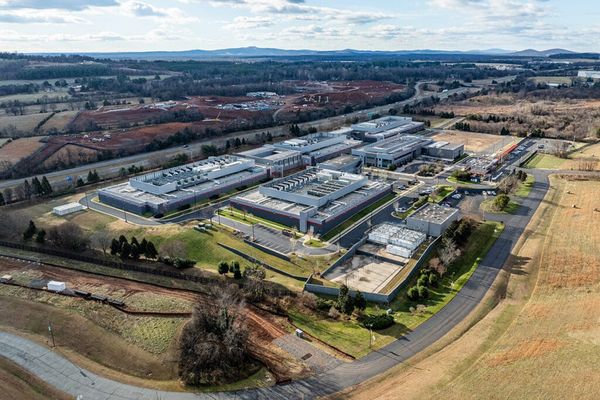
For businesses, traditional insurance is needed to cover losses. A multi-billion-dollar data center owner wants to be covered if a battery overheats and a fire takes out racks of expensive GPUs. That much is clear. But businesses face plenty of financial risks that aren’t a defined loss event or don’t fit neatly into an insurance policy. A surprise tariff on shrimp can hit a restaurant's bottom line. Who’s in office can determine the fate of a data center. For a long time, these risks didn’t have a market. With the advent of prediction markets, they just might. If an event can move a company's bottom line, could a contract that pays out when that event happens serve as a hedge?
It’s early, but a few businesses are already putting the idea into practice. Just a few days ago, Pillar, an AI-powered risk management platform, placed what it called the first-ever tungsten price hedge for a metals distributor on Kalshi and Susquehanna Predictions. Tungsten is a key component in munitions, jet engines, and semiconductor manufacturing, among other industries. Tariffs and export restrictions have sent prices soaring, threatening the margins of businesses that buy and sell the metal.
The significance of the tungsten deal goes beyond a novel bet on a commodity price. It shows how prediction markets could give businesses a new way to transfer risk that traditional insurance doesn't cover. The same logic could apply to a restaurant exposed to shrimp prices or a data center developer exposed to election outcomes. When an event can materially affect a business's bottom line, a contract that pays out when that event occurs can help offset the exposure.
The challenge is turning that basic idea into a reliable, repeatable risk-management tool. That's hard. That's what the multi-trillion-dollar insurance industry has spent centuries figuring out.
That’s also why prediction markets won’t replace insurance. When a fire takes out a data center, the owner needs coverage for the actual damage. Kalshi can’t offer that. Whether a specific data center burns depends on its own sprinklers, maintenance and safety practices, and the owner knows far more about those than any trader. Kalshi’s own rules bar trading by anyone who has inside information about an outcome or can influence it. Insurance on the other hand, is built for exactly that problem: the owner tells the insurer what they know, the insurer prices it, and the policy sets the terms.
Far from replacing insurance, prediction markets are playing an increasingly important role in helping carriers. For new risks like AI and robots, there’s little or no loss history to price from. Market odds give underwriters a live read on the events around those risks, like whether a new AI law passes or how fast robotaxis spread, updated every day by the betting man. That's speculative, of course and silly to conflate the market's odds with actuarial science. But when conventional data is limited, even an imperfect signal could help businesses and insurers reason about risks that would otherwise be difficult to quantify.
Prediction markets can also help with insurance’s other problem: capacity. Carriers steer clear of risks that are systemic or hard to model, and Marsh’s global head of parametric solutions has said prediction markets could bring in new capital to cover them, from hedge funds and other traders. Some insurers are already testing it. Game Point Capital, which insures bonuses for sports teams, has used Kalshi to cover its own exposure at roughly half what traditional reinsurance would cost.
Though for prediction markets to become reliable risk-transfer tools, businesses need to know how to translate their exposure into a contract that actually offsets the risk. That means figuring out which event to bet on, how much the business stands to lose, and whether the contract will pay out at the right time and in the right amount. Then there's liquidity: a hedge is only useful if there's a market big enough to take the other side.
Take the data center example. A Democratic sweep of the House and Senate doesn't necessarily spell trouble for data center owners. Politicians pay lip service to policy changes all the time without following through. And even if a blue wave does hurt data centers, how much exposure does that create for the business? Is there even a market deep enough to offer a meaningful hedge?
Prediction markets may be creating new ways to price risk, but turning market prices into practical financial protection will take a lot of work.
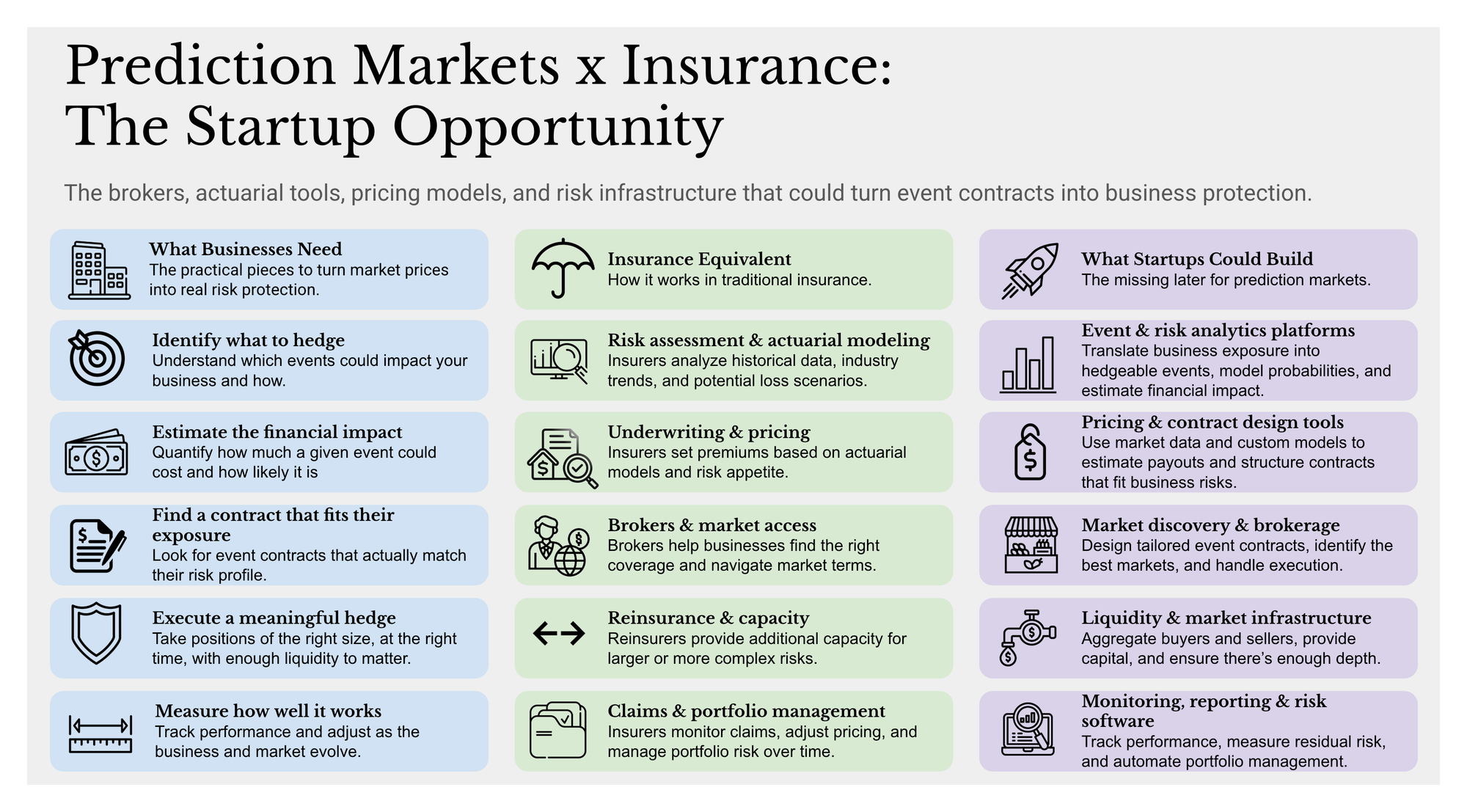
This is where prediction markets have a lot of catching up to do with insurance. This is also where insurance provides a useful case study for how the prediction markets might evolve. The insurance industry has spent centuries building the infrastructure to make risk transfer work: actuaries who model the likelihood and cost of losses, underwriters who decide which risks to take on, brokers who help businesses find the right coverage, and reinsurers who provide the capacity to cover large losses. Prediction markets have the contracts and, increasingly, the trading activity. But turning those markets into something a business can reliably use to hedge its exposure requires a similar ecosystem.
Someone has to design the right contracts, model how they map to real-world business risks, help companies figure out how much to hedge, and make sure there's enough liquidity to support meaningful positions.
That's the opportunity.
To make prediction markets effective risk-transfer tools for businesses, they’ll need the same kinds of intermediaries that make insurance work: brokers, actuaries, underwriters, and the like. Here's how each part of the insurance ecosystem maps to the infrastructure prediction markets needs, and the startups that could exist to support it.
The Kalshi tungsten contract is a nice proof of concept for what could be an entire industry spawned from fun bets. It’s still early, but prediction markets don’t need to replace insurance to matter. They just need to make more risks measurable, tradable, and ultimately hedgeable than they are today. If they can do that, the market for risk transfer could get a lot bigger – and there may be a whole new category of companies built to serve it.
I said it here first. Come back for more Airbnb-esque predictions.