The Lesson It Missed
A three-act story about what venture capital keeps getting wrong about insurance


A few weeks ago, the Instagram algorithmic gods put me on to Save the Cat! Writes a Novel: The Last Book on Writing You'll Ever Need. I devoured it. Zuck (or god) must have read my Notes app, seen the pile of ideas for a novel I keep telling myself I'll write someday, and taken pity. Save the Cat! is a masterclass in story structure, giving writers a beat-by-beat blueprint to turn a raw idea into a compelling arc. And while I’m putting it out into the universe that I will write a novel someday, today is not that day.
Today, we’re applying screenwriting theory to the glamorous world of insurtech.
In classic storytelling, the first act establishes the world as it is, until something happens that makes the old way unworkable. The second act is where the hero changes and finds out that changing wasn't enough, and the third act is where they figure out what they actually wanted.
Insurtech is living its second act. The class that raised billions got repriced, capital moved to safer ground, and the industry learned exactly one lesson from it. This is a story about the one it missed, and what the third act has to look like.
Here is how the story unfolds, starting with how we got here.
Act One: What 1.0 Solved
Insurtech as an independent venture capital category formed some time around 2014-2016. The opportunity and the mandate were clear. Even back then, carriers were collecting $1.32T in premiums in the US alone, and had done so largely using old, stodgy mainframe technology from the 80's. Founders and investors saw an opening to disrupt legacy players with new API-driven cloud technology and a shift in consumer buying behavior brought on by smartphones. They were emboldened by analogous success stories in banking and payments.
Companies like Root Insurance, Lemonade, Metromile, and Hippo formed during these years to change the way insurance was bought, sold, and underwritten. Traditional carriers priced risk using lagging demographic proxies — claims, credit scores, zip codes, age, marital status. Insurtech 1.0 believed underwriting should be more direct. Root introduced telematics to auto underwriting, using smartphones to track drivers' actual habits. Metromile invented pay-per-mile insurance. Hippo bundled smart home sensors with policies and used aerial imagery to analyze roof condition instead of sending an inspector. Lemonade issued a renters policy in under 90 seconds and assessed claims immediately, sometimes paying instantly. Many skipped the agency networks entirely and bought their customers straight from the same algorithmic gods who sold me the book.
Leveraging reinsurance to offload large claims is not a new strategy, but insurtech 1.0s relied on this structure more heavily than traditional carriers. Lemonade reinsured as much as 70–80% of its book compared to just 10–15% by traditional carriers. This allowed them to free up capital and pursue the dominant playbook of the time: market share over profitability. It also let them look like something they weren't. Ceding most of the risk made the balance sheet read like software. That was on purpose.
The Catalyst
In Save the Cat!, the catalyst is the thing that forces our hero to change.
The year is 2021. Up until this point, the world of insurtech looked pretty great. Lemonade, Root, Hippo and Oscar Health all went public at impressive valuations. Riding off of their success, insurtech startups collectively raised $15.8B across 564 deals that year. The category was declared proven, and investors patted themselves on the back for having transformed another antiquated industry. And yet.
In 2022, both public and private market sentiments completely changed. Lemonade soured (and not in that nice, makes-you-salivate-from-the-sides-of-your-cheeks kind of soured) from an all-time high of $183.26/share to $13.68/share by the end of 2022. Root took $300M in financing from BlackRock to stay funded then did a 1-for-18 reverse split to avoid delisting. Metromile, which IPO'd via SPAC at $1.3B, was acquired by Lemonade — announced just nine months after it started trading — at under $200M net of cash. And Oscar, which made its public debut at a 16.6x multiple, SaaS-like figures, fell with the rest of them. VCs were spooked and took their money with them. You cannot underwrite a private round at fifteen times revenue when the public version of that company trades at one. Insurtech investments by dollars nearly halved in 2022 and halved again in 2023, to the lowest annual total since 2018.
Gallagher Re's global head of insurtech would later call 2021 "the Great Experiment," and 2023 "the beginning of a new phase involving a sustained change in investor behaviour."
The world as it was needed to change.
Act Two: Where We Actually Are
The dominant lesson from the early insurtech years was that insurance carriers cannot be priced like SaaS companies. Traditional carriers may have been slower to leverage cloud technology, but they always understood fundamentally what insurance is about.
So the industry responded. Here's a market map I created to show today's insurtech landscape: how the top insurtechs are distributed, and the rough funding each bucket has received.
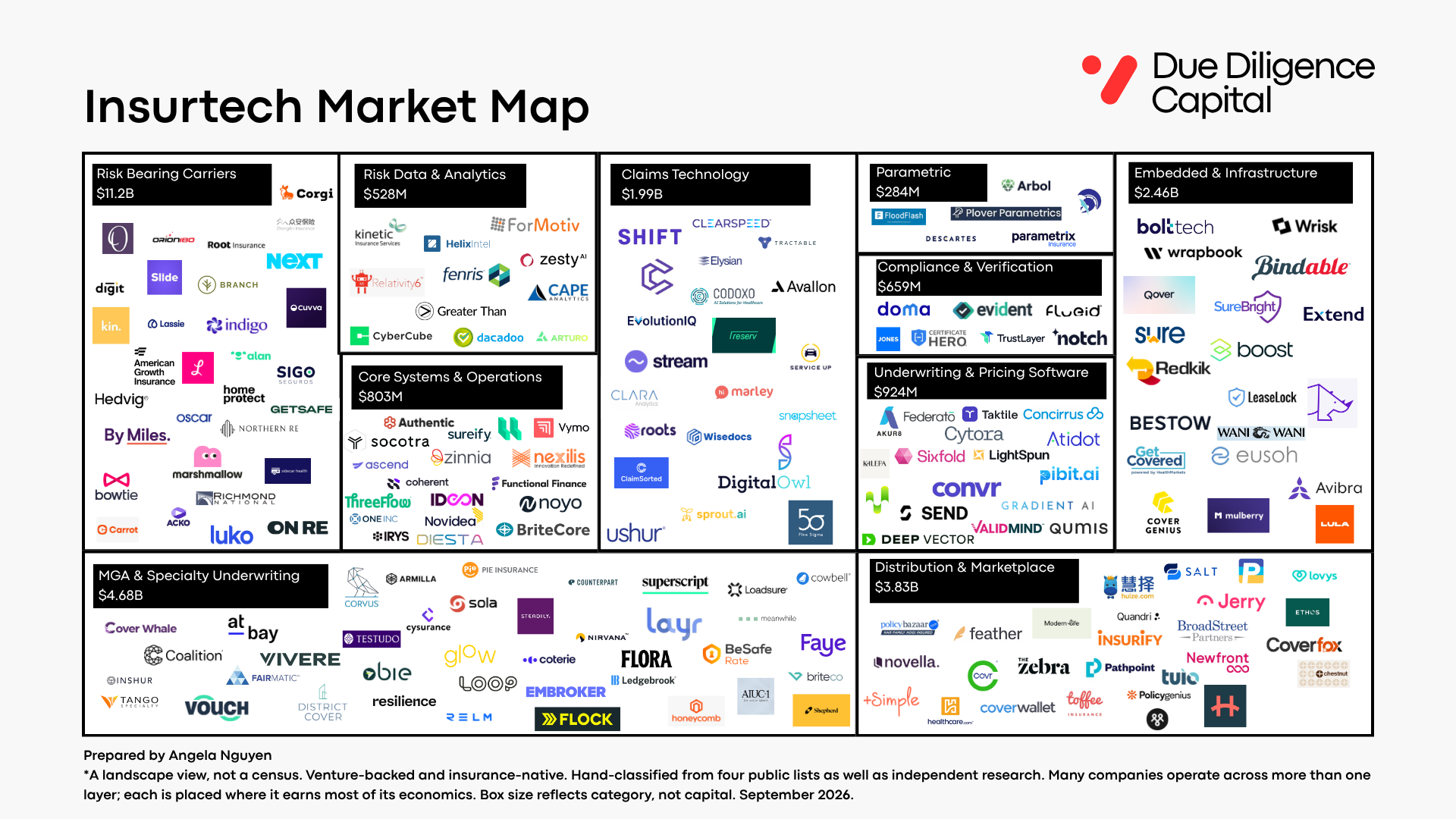
Risk-bearing carriers, although still the largest bucket by total funding amount, cooled immediately after the 2021 class was repriced. Instead, the investors still bullish on insurtech bet on insurance software with AI layered on top of it — a model VCs know, love, and can reliably make money on — or MGAs with authority to underwrite and bind but which don't hold the risk. Insurtech darlings of this current era include Sixfold, Federato, Akur8, EvolutionIQ, and Coalition. It's a sign that private markets are aiming to empower incumbent carriers rather than replace them.
To be sure, I'm not saying VCs shouldn't invest in carriers. Indigo is building a real specialty book. The bet is fine. Just know you're buying a book nobody can grade yet.
And then there's Corgi.
The commercial insurance underwriter of seven-day-work-week fame raised three rounds in eight weeks this summer, closing the last at a reported $4B. Corgi was at $40M of annualized revenue in January and is reportedly tracking to $450M by year end. That's not the 2021 mistake repeating. Its valuation grew slower than its revenue, so the multiples actually look okay.
What I keep looking at is the structure. Corgi writes part of its book through a Risk Retention Group — a self-insurance pool that sits outside much of state regulation and isn't backed by state guaranty funds. If the pool runs dry, the members eat the loss. And the lines it writes are long-tail, where you find out whether you priced correctly three to five years later. The company was founded in 2024. Almost none of its claims have developed yet.
What's more, Corgi targets startups. A book of venture-backed startups has no diversification and no stability — the same cycle moves all of them, and half will be selling something different by renewal.
Premium always comes before claims. Insurtech 1.0 treated premium like revenue when it's really cash held against a bill waiting to be collected. Insurance is a latency game, and that lag is why the metrics that tell a VC a startup is working — revenue, growth rate, retention — tell you almost nothing about whether an insurance company is working. For an MGA or a carrier, premium collected measures how much risk you've taken on, not how well you've taken it on. The bill arrives later, and sometimes all at once. Suddenly that $450M doesn't look so good.
Insurtech 2.0's dominant answer was to stop holding the risk. Sell software to the carriers instead, or hold the pen and let someone else's balance sheet absorb the loss. That's most of the map.
But the safer structures aren't free lunches either. An MGA writes on someone else's paper, and that paper can go away overnight — the carrier pulls back when loss ratios turn, or decides it would rather write the book itself. Software has its own problem: selling into insurance means long sales cycles, procurement committees, and buyers who have run the same policy admin system since the nineties. Venture doesn't offer safe.
The market got more careful about where it stands. It hasn't gotten more careful about what it counts.
Bad Guys Close In
This is the beat in Save the Cat! where the pressure mounts and the hero's fixes stop working. The walls tighten while they're still running the old plan.
Physical AI. Not bad guys in an evil sense, just the thing that ups the ante.
In previous pieces, I wrote about an emerging class of risk unlike anything the insurance industry has seen. Hyperscale data center campuses worth tens of billions each, clustered in the same few locations. Fleets of humanoid robots coming into warehouses and factories, whose strength surpasses ours and which can act on their own. If VC capital is a leading indicator, AI is making its way into our physical world very quickly.
None of it has a loss history. They're risks nobody has confidence pricing, because the losses haven't happened yet, so there's nothing to learn from.
So here's where we are. Insurtech 1.0 taught us not to value insurance companies like software companies. Insurtech 2.0 mostly solved that by building things that aren't insurance companies — and where it still backs one, it counts premium as proof the thing is working. Neither generation learned to read an insurance business on its own terms. And now a class of risk is arriving that is genuinely tough to price.
Insurtech 3.0 has to start somewhere different. Not with a better model, and not with a cleverer structure. With the data that makes these risks measurable in the first place.
Act Three: What The Next Wave Has To Do
Models are only as good as what they're fed. The underwriting software that dominated the second wave of insurtechs – Federato, Sixfold, Akur8, Taktile – improves how a decision gets made on data that already exists. For auto and home, that's enough. There's a century of loss data, weather patterns, and human behavior underneath to feed those models. For data centers and humanoid fleets, the data is shallow to nonexistent. There's nothing flowing in to feed the models. Someone has to go out and measure the thing.
That's not a model problem. That's a data problem.
The Risk Data & Analytics bucket of the market map has collectively raised $621M by my count. That's thin. Even then, big data players are not taking chances. Moody's bought CAPE Analytics in 2025. Verisk projects that global data centers will generate $23B in premium by 2030 - more than double today's figure - and launched a US Data Center Exposure Database this month. They know where the gap exists, and they are moving in to fill it so that their models stay competitive.
If I have convinced you that data companies are where the next wave of insurance gets built, you might want to look outside of insurtech. The largest raise in this layer, over €1B, went to a satellite company nobody funded as insurtech. Clearspeed, which has defense origins, raised a $60M Series D in 2025. Some of the best data companies will have multiple use cases, with insurance as just one of them, and maybe not even the main one.
But assembling the data is just the start. Whoever holds it has to decide what to do with it, and there are three ways to go: bear the risk, hold the pen, or sell what you know. Only the last one lets you keep the other markets, but they all come with trade offs.
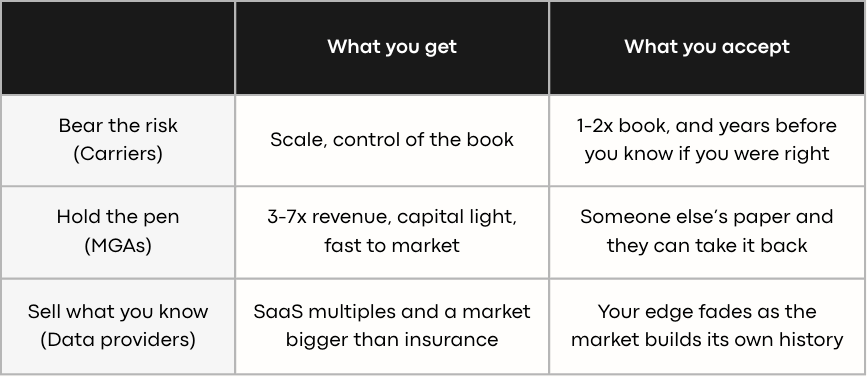
As an investor, the right investment largely depends on what you can get access to, what you can afford, and the value you can provide.
A small insurtech fund may not have the capital to keep up with the many funding rounds required to keep a Corgi afloat, nor can it be competitive against a defense tech fund in pursuit of a satellite company. What it can do, however, is get in early and be the investor on the cap table able to walk the founders into the room with Chubb's chief underwriting officer.
A mid-sized fund has a different opening. The MGA is the only door that reaches venture scale on a venture clock, and Coalition at roughly $5B is the proof. MGAs are also purely insurance — no climate fund or defense fund is going to bid against you for an MGA, because there's nothing in it for them. The catch is that an MGA writes on someone else's paper, and that paper can go away. The carrier can decide it would rather write the book itself, or non-renew if loss ratios turn. So this is a portfolio bet, not a conviction bet. Expect to lose one.
Large funds get the doors nobody else can afford. Carriers need surplus, and surplus needs round after round. Corgi raised over $374M in under two years and is still raising. The heavy end of the data layer is the same story: you cannot put sensors on 2,500 data centers, or satellites in orbit, on a seed round. That capital is the moat, and it's the reason the billion-dollar outcomes in this layer keep going to the funds who can build one.
The through-line of course is that the data layer needs to be built first. From there, investors and founders alike can choose their own adventure.
Final Image
The insurtech story is still being written. If we're realistic about venture timelines, we're only five years out from "the great repricing." Act Two is still very much in play, and the winners of this era remain to be seen.
But if this story is going to end well, it needs to absorb the lessons from the past. Build the layer the industry needs first. Make the next move with eyes wide open about the trade-offs. And stop treating premium like revenue.
I'd like to imagine a version where the industry finally gets it right. Carriers offering adequate capacity because they can underwrite with precision. MGAs out in front of the risks nobody has figured out yet, proving that better data makes for better books. And the companies doing the measuring getting properly paid for the thing everyone else is built on. Our hero, finally redeemed as a respectable investment category.
None of that happens until somebody goes out and measures it.
*The market map merges four public company lists, hand-classified by business model. Trackers routinely file MGAs as software; where that happened I reclassified. Funding figures are directional, not exhaustive.